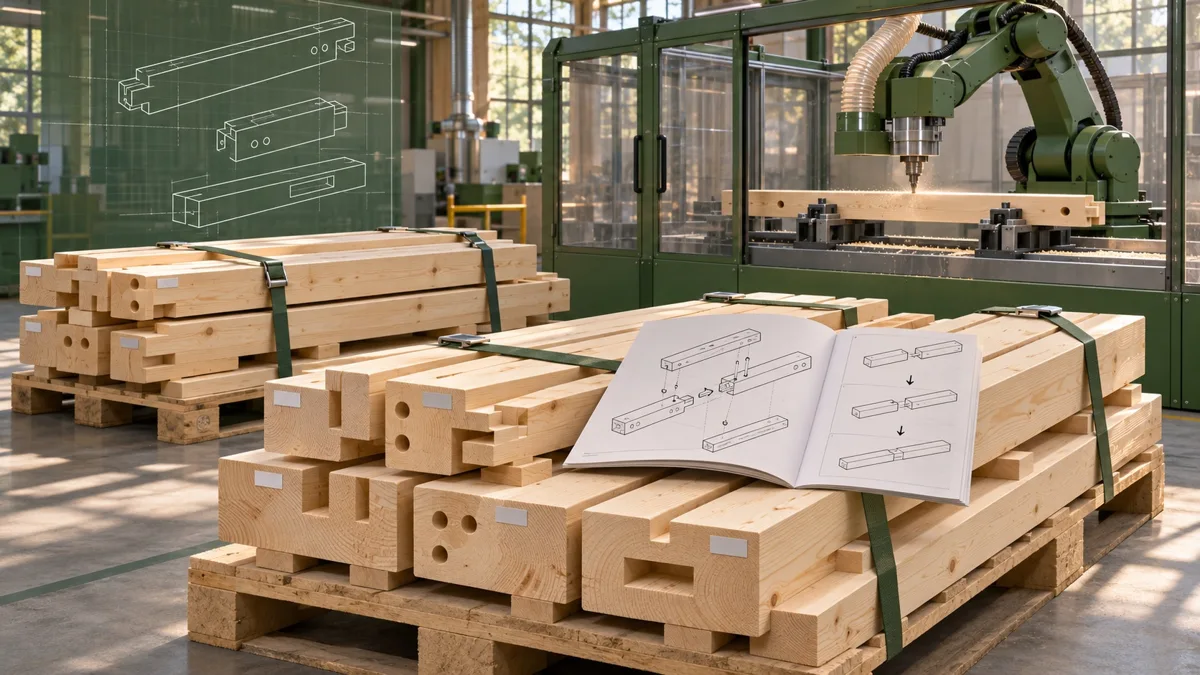
The timber parts are on the pallet. On site, they need to become a structure. Between the two lies the crucial work: What needs to carry the loads? Where should the joint be? And how should the parts be machined and assembled?
At WoodStocks, the delivery is a building kit consisting of timber parts on pallets and an assembly guide. The structure itself is assembled on site. Here, robot engineering is about the connection between the digital structural design and the machining of the individual parts.
The research covers a broader scope: ETH Zürich has also demonstrated robotic placement of beams. That example is discussed later as a separate research project, not as a description of the WoodStocks delivery model. [1]
The most important tool is also a decision
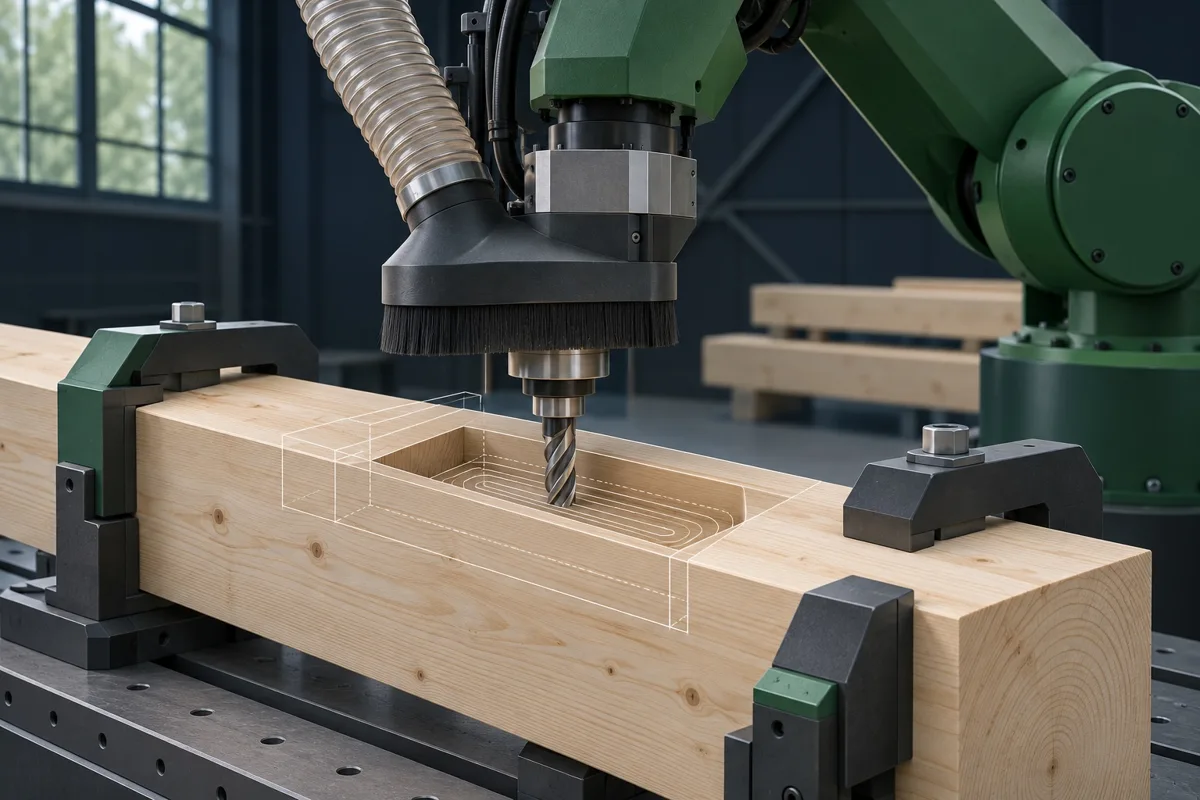
A joint can look elegant on screen and be difficult to produce. That is why robotic production is more than sending a drawing to a machine. In the BUGA Wood Pavilion project, Universität Stuttgart developed the structure and robotic fabrication in close coordination. Geometry, structural considerations and production were treated as interconnected design tasks. [2]
For a carpentry business, this is a useful perspective: Ask for the production requirements to be clarified while the project can still be adjusted. The question is both what the structure looks like and how it will be manufactured, handled and assembled.
Has the project merely been drawn – or has it also been thought through for production and assembly?
A 3D model is the start of the conversation
BTL and BTLx were developed for data transfer between design software and CNC machines for timber construction. The formats describe the geometry and machining operations of timber components parametrically and contain information for prefabrication and assembly. This makes them relevant to the connection between design and production. [3]
This is an important distinction from simply displaying a model on a screen: The production process must account for the actual machining operations. For each project, the software, file format and machine capabilities should therefore be coordinated with the manufacturer.
The technology is also available as commercial machinery. For example, Hundegger describes ROBOT-Drive as having a six-axis robotic unit and tool changing for operations including cutting, drilling, milling and marking. This is the manufacturer’s description of the machine’s functions; it does not in itself indicate how much a particular construction project saves. [4]