More time to build.
Less work prior to assembly.
Why choose a robot-cut timber building kit? Because a good build begins long before the first member is raised. We look at precision, preparation, and the value of having components delivered ready for the next step.

There is a big difference between receiving a pile of lumber and receiving components machined for the specific project you are building. On the job site, both count as materials. But they result in very different working days.
With a robot-cut timber building kit, part of the layout and machining is shifted forward in the process. The drawings form the basis for production, and the components are cut to size before they arrive on site.
This makes it possible to spend more time assembling the structure and moving the build forward.
THE ESSENTIALS IN ONE MINUTE
- Digital fabrication can provide uniform precision in the individual components.
- Pre-cut components can reduce the need for site adjustments.
- Labeling, packaging, and documentation are an important part of a good delivery.
- The result depends on the project documentation and the agreed scope of delivery.
From drawing to parts that fit together
Robot cutting is computer-controlled processing of timber. Depending on the machine and the project, it can include cutting to length, drilling, and routing or milling of joints.
When machining is based on thoroughly detailed digital production documentation, parts can be manufactured with consistent precision. CNC technology is used specifically for the prefabrication of timber components and precise connections in timber construction.[1]
For the carpenter, the value is tangible: more details are resolved before the parts are assembled. But precision begins with the project. A machine can only fabricate according to the data it receives; it cannot make incorrect dimensions right.
More of the work is done prior to delivery
Imagine a timber structure with many components and various joints. If machining only takes place on the job site, there must also be time, space, and equipment for that part of the work.
With prefabricated components, part of the fabrication can be completed upon arrival. This can ease assembly and reduce the time spent on site adjustments. The manufacturer Pabst describes installation-ready components and reduced time spent on the construction site as benefits of digitally planned CNC machining.[2]
How significant the difference is depends on the structure, the project documentation, and the planning. A good result also requires that the foundation, site access, and the rest of the job site are ready for delivery.
A kit must be straightforward to navigate
When components are labeled, documentation is straightforward, and packaging aligns with the assembly sequence, planning the work becomes easier. The connection between numbering, delivery, and a planned assembly sequence is also part of WoodWorks' description of prefabricated timber elements.[3]
Therefore, it is worth asking about more than just the cutting itself: How are the parts identified? Which drawings are included? And how does the delivery match the sequence in which the structure is to be assembled?
See the robot at work.
A look at the robotic process from WoodStocks' factory page. Play the video to see the movements in production.
Video: WoodStocks' existing factory page. The video only plays when you press play. It shows the robotic process and does not in itself document a specific precision or savings.
OVERVIEW / FROM PROJECT TO ASSEMBLY
Preparation carries through the entire process.
Project and drawings
Dimensions, intended use, and structural design form the basis for the review.
Review and agreement
Fabrication, documentation, and scope of delivery are clarified.
Production and packaging
The components are machined according to the approved production documentation.
Delivery and assembly
The parts fit into the planned sequence on the job site.
Conceptual process. Specific services, scopes of responsibility, and deliverables depend on the project and the agreement.
The timber build takes shape.


Images from WoodStocks' existing website. No unconfirmed client names, locations, or project results are associated with the images.
Opportunity for better timber utilization
Digital planning allows for optimizing cuts and making better use of the selected timber lengths. For example, timber manufacturer Carolina Timberworks describes how their CNC software optimizes cuts to reduce waste.[4]
The benefit depends, among other factors, on dimensions, lengths, and the structural design. This makes material consumption a relevant part of planning.
However, robot cutting is not in itself documentation of a specific CO₂ reduction. Such an assessment requires data on the specific build, materials, production, and transport.
A clear basis before production
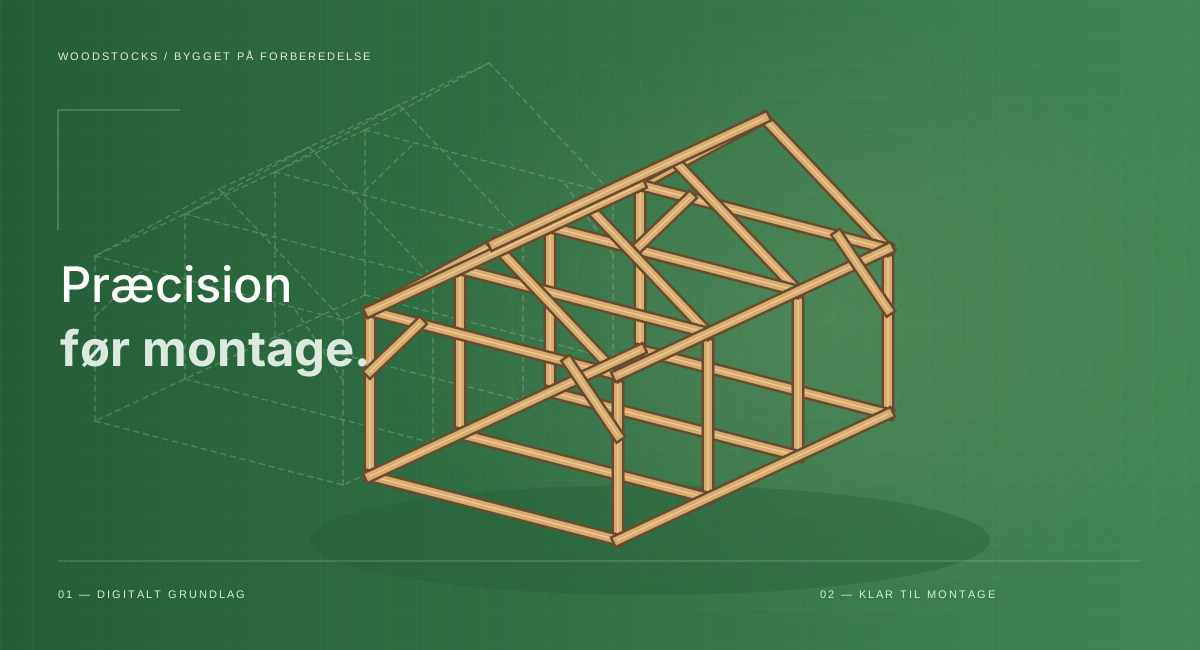
Dimensions, joints, and the scope of delivery must be sufficiently clarified before components are machined. It is also an opportunity to resolve questions that might otherwise arise mid-build.
What is delivered? Who is responsible for which tasks? How does the timber structure interface with the foundation and the other building components?
A joint review before production gives the parties a clearer basis to work from. Changes may still become necessary, but the more thoroughly the project is clarified, the better the starting point.
Craftsmanship is still crucial
The carpenter's trade expertise is central, even when parts arrive pre-machined. The structure must be handled, positioned, assembled, and verified correctly. Tolerances, moisture, fasteners, and integration with the rest of the build must still be properly managed.
Robot-cut components can support this work by shifting repetitive machining into production. On the job site, the crew can thus concentrate on assembly and the conditions that require professional judgment on site.
Is a timber building kit relevant to your project?
It starts with your drawings and what you want to build. Investigate which components can be prepared, what documentation is required, and how the delivery should fit into the construction process.
The specific quote must make it clear what is included — including machining, labeling, documentation, and any other services.
A good building kit begins with a solid foundation. And we create that foundation through dialogue about your project.
Sources and technical basis
- WoodWorks: Mass Timber Constructability and Costing — prefabrication, tolerances, and CNC-machined connections.
- Pabst Holzindustrie: Joinery service — digital planning and assembly-ready components.
- WoodWorks: Mass Timber Construction Workshop — numbering and planned delivery and assembly sequence.
- Carolina Timberworks: Timber Framing Tools — CNC machining and cut optimization.
What do you want to build?
See the possibilities with timber building kits, or start a dialogue with us about your drawings, the project scope, and next steps.